
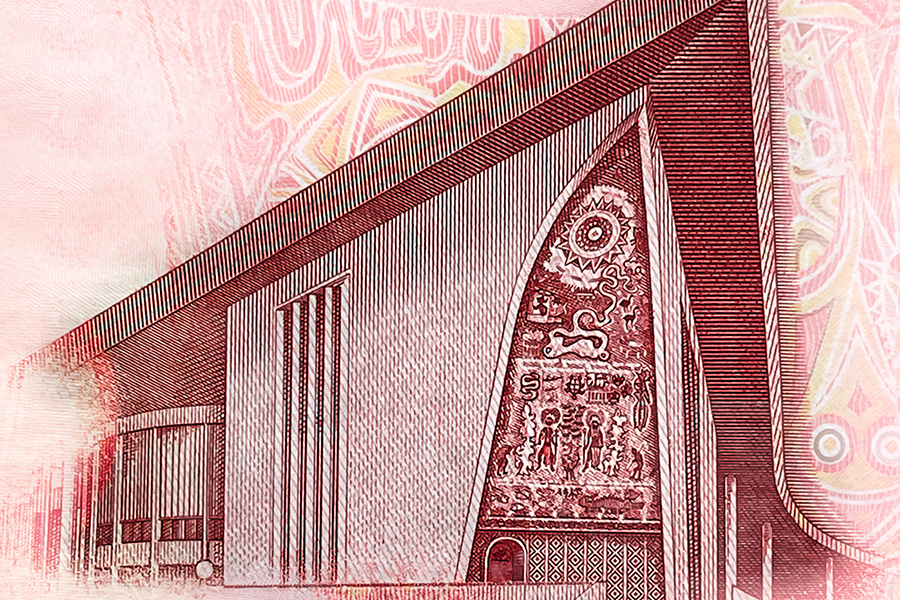
The National Parliament House of Papua New Guinea (PNG) stands as a striking symbol of national unity and cultural heritage. Designed by Australian architect Cecil Hogan, the then National Works Chief Architect of PNG, the building’s vision was to incorporate architectural styles and traditions from all four regions of Papua New Guinea into a single cohesive structure. The design drew inspiration from the “Haus Man” or Men’s House, a central structure in traditional village society used for communal decision-making.
In 1980, Fletcher Construction, a New Zealand based company, was awarded the contract for the construction of the Parliament House, which took approximately 4 years to complete at a cost of K24.4 million. The Parliament House was officially opened on August 7, 1984 by Prince Charles of Wales, now King Charles III.
The Parliament House serves as both the physical and symbolic heart of the nation’s governance. The building seamlessly integrates traditional PNG architectural styles and is adorned with remarkable artworks and carvings by some of the country’s most renowned artists, including Akis, Jakupa, Mathias Kauage, Gikmai Kundu, Cecil King Wungi, and Bennie More. Together, these elements celebrate PNG’s rich cultural diversity, with its thousand distinct tribes unified under one national identity.
One of the first major initiatives approved by Grand Chief Sir Michael Somare after becoming PNG’s first Prime Minister, the Parliament House not only functions as the legislative hub of the country but also stands as a testament to its diverse cultural identity and collective governance.
However, in 2013, controversy struck when the then Speaker of Parliament, the late Theodore Zurenuoc, ordered the removal of traditional carvings from the Parliament House. He tore down the lintel, desecrated the Speaker’s Chair, and removed other traditional carvings, labelling them as evil and ungodly. In response, Grand Chief Sir Michael Somare challenged the Speaker’s actions in court. The court ruled in favour of Grand Chief Sir Michael Somare, finding that Zurenuoc had acted unconstitutionally and violated the National Cultural Property Act. The court ordered the restoration of the totems and traditional carvings to the Parliament House.
This case underscored the deep cultural significance of the Parliament House and affirmed its role as a symbol of PNG’s unity and respect for its heritage.


Leave a Reply